
Adapt the solved exercises to your subject. Register for free
(6) Perform the following operations using the cardinality of the following sets:
Given #(A)=2, #(B)=5, #(C)=20 perform the following operations.
1. [Exercise 41]
If (A ∩ B) are disjoint, #(A ∩ B)
#(A ∩ B)= #(A) + #(B) - #(A ∩ B)
#(A ∩ B)= 2 + 5- 0
#(A ∩ B)= 7
2. [Exercise 42]
If C is disjoint to (A ∩ B) and A={a,b} and B={b, c, d, f, g}, What is the cardinality of # ((A ∩ B) ∪ C)?
3. [Exercise 43]
If A={a,b}, B={b, c, d, f, g} and C={a, b, c, d, e, f, g, h, i, j, k, l, m, n, o, p, r, s , t, v} What is the cardinality of
# ((B ∩ C) ∪ A) ?
B ⊂ C, therefore, the cardinality of #(B ∩ C) will be the cardinality of #(C)
#(B ∩ C) = 20
A ⊂ C, therefore, #(B ∩ C) = #((B ∩ C) ∪ #(A))
#((B ∩ C) ∪ #(A))=20
4. [Exercise 44] With all sets being disjoint, calculate
#((A∪ B) - (A ∩ B))
5. [Exercise 45]
If C is disjoint and A and B have two elements in common, calculate
#([(A ∩ B) ∪ C)] - [(B ∩ C) ∪ A])?
| (A ∩ B) ∪ C) | (B ∩ C) ∪ A |
|---|---|
#(A)=2, #(B)=5, #(C)=20 A ⊂ B #(A ∩ B)= 5 #(A ∩ B) = 5 #((A ∩ B) ∪ C)= 25 |
#(A)=2, #(B)=5, #(C)=20 #((B ∩ C))= 25 #(A)=2 A ⊂ B #((B ∩ C) ∪ A)= 25 |
#([(A ∩ B) ∪ C] - [(B ∩ C) ∪ A)])= 25 - 25= 0 |
|
#([(A ∩ B) ∪ C)] - [(B ∩ C) ∪ A])= 0
Set cardinality problems:
6. [Exercise 46] Suppose a bank has conducted a survey about the economic situation of Spanish families. According to the survey results, 30% of families were paying a mortgage loan, 40% were paying a car loan, and 10% were paying both loans. The bank wants to know what percentage of families pay neither mortgage loans nor car loans.
Solution:
By proportionality, it suffices to reason about a universe of 100 families. Let's call A the set of families, among the 100, that are paying a mortgage loan and B the set of families paying a car loan. According to the data, out of every 100 families, 30 belong to A and 40 belong to B, therefore, #(A)=40 and #(B)=30 hence #(A ∩ B)= 10. Then, those paying either of the loans will be:
#(A ∪ B) = #(A) + #(B) - #(A ∩ B)
= 30 + 40 - 10
=60
and those who don't pay either of the two loans will be
#((A ∪ B)c) = #(U) - #((A ∪ B))= 100 - 60= 40
7. [Exercise 47]
8. [Exercise 48] Suppose that at a meeting there are 40 people who speak some of the languages German, Spanish, or English. It is known that 22 speak German, 26 don't speak English, 30 speak only one language, 30 speak English or German, 7 speak English but don't speak Spanish, and 17 speak German but don't speak Spanish. We want to answer questions like: How many people speak all three languages? How many people speak only Spanish? How many speak Spanish but don't speak English?
Solution:
Let's call A, B, and C, respectively, the sets of people who speak German, Spanish, and English. All the relationships between these sets can be represented in a Venn diagram:
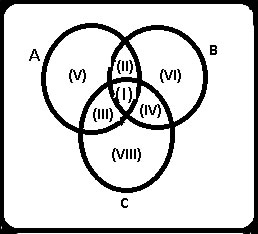
If we formalize the data that appear in the statement, we will have the following data:
| Number | Statement | Formalization | Cardinality | Quantity |
|---|---|---|---|---|
| 1 | Total People | A ∩ B ∩ Cc | #(I) +#(II) +#(III) +#(IV) +#(V) +#(VI) +#(VII) = | 40 |
| 2 | Speak German | A ∩ B ∩ Cc | #(I) +#(II) +#(III) +#(V)= | 22 |
| 3 | Don't speak English | A ∩ Bc ∩ C | #(II) +#(V) +#(VI)= | 26 |
| 4 | Speak only one language | Ac ∩ B ∩ C | #(V) +#(VI)+#(VII)= | 30 |
| 5 | Speak English or German | A ∩ Bc ∩ Cc | #(I) +#(II) +#(III) +#(IV) +#(V) +#(VII) = | 30 |
| 6 | Speak English but not Spanish | Ac ∩ B ∩ Cc | #(III) + #(VII) = | 7 |
| 7 | Speak German but not Spanish | Ac∩ Bc ∩ Cc | #(III) + #(V) = | 17 |
How many people speak only Spanish?
Answering this is simple. (2) are those who speak English or German. If we subtract (2) from the total number of people (1), we get the number of people who only speak Spanish.
(1)= #(I) +#(II) +#(III) +#(IV) +#(V) + #(VI) #(VII) =40
(2)= #(I) +#(II) +#(III) +#(IV) +#(V) +#(VII) = 30
#(VI)=#(1)-#(2)
#(VI)=10
The people who only speak Spanish are 10.
How many people speak all three languages?
To discover this figure, it is necessary to perform more operations... Let's observe the number of people who speak only one language (4)
#(4)= #(V) + #(VI) +#(VII) = 30
#(VI)= 10
#(V) + #(VII) = 20
We know that 10 people only speak Spanish. Therefore, we can deduce that 20 people either speak English or speak German.
Now let's discover the number of people who speak English but not Spanish and the number of people who speak German but not Spanish. And with this data, along with our knowledge of the number of speakers who only speak English or only speak German, we will deduce those who speak Spanish and English:
#(6) +#(7)= 2x#(III) +#(V) + #(VII)=24
#(V)+#(VII)=20
2x#(III)=4
#(III)=2
We already know that the number of people who speak Spanish and German is 4 (#III). Now it's easy to deduce those who only speak English and those who only speak German.
#(6)= #(III) +#(VII)=7
#(III)=2
#(VII)=5
5 people only speak English (#VII).
#(7)= #(III) + #(V)=17
#(III)=2
#(V)=15
15 speak German only.
Knowing those who don't speak English #(2) and those who speak German #(V) and those who speak only Spanish #(VI), we can deduce those who speak German and Spanish #(II).
#(3)=#(II) + #(V) +#(VI)=26
#(V)= 15
#(VI)= 10
Therefore, #(II)=1
Since we know those who speak German #(2), those who speak German and Spanish #(II), those who speak English and German #(III), and finally, those who speak only German #(V), we can definitively deduce the number of people who speak all three languages.
#(2)=#(I)+#(II)+#(III)+#(V)=22
#(II)=1
#(III)=2
#(V)=15
Therefore, #(I)= 4
How many people speak Spanish but not English?
First, we will deduce the value of #(IV) using the available data and using #(5):
#(5)= #(I) +#(II) +#(III) +#(IV) +#(V) +#(VII) = 30
#(I)= 4
#(II)= 1
#(III)= 2
#(V) = 15
#(VII)= 5
Therefore, #(IV)= 3
and with this data we deduce through this operation the number of Spanish speakers who don't know English:
#(IV) + #(VI)=
#(IV)=3
#(VI)=10
15
The number of Spanish speakers who don't know English is 15.
Exercise solved!
9. [Exercise 49] A survey reveals that one in four Spaniards is a football fan and that one in ten is a basketball fan. There is no data about how many Spaniards share both hobbies. Under these circumstances, it cannot be determined exactly how many Spaniards have either of these two hobbies. However, it can be assured that this number will not exceed the sum of football fans and basketball fans. Since out of every 100 Spaniards, there are 25 football fans and 10 basketball fans, it can be assured that the percentage of Spaniards who have either of these hobbies does not exceed 35%.
10. [Exercise 50] If 80% of students in a course pass subject X and 70% pass subject Y, out of every 100 students, set A of those who passed X has cardinality 80 and set B of those who passed Y has cardinality 70, How many have passed both subjects?
Solution:
#(A ∩ B) ≥ #(A) +#(B) -#(U)= 80 + 70 -100=50
Therefore, at least 50% of students will have passed both subjects.
Return